Tech Leads Convene to Navigate the Future of Software Engineering in AI era
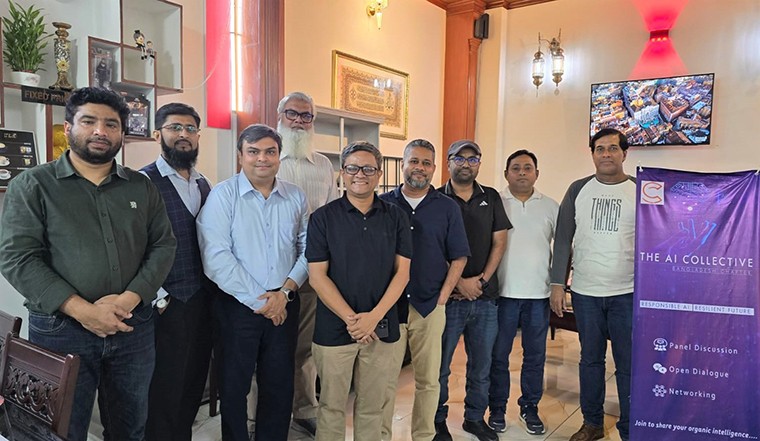
C.B.Desk: The AI Collective Bangladesh Chapter recently hosted an exclusive “Tech Pros’ Meetup” at a local café in Dhaka. The event brought together the leading CTOs, Software Engineering Leads/Architects to discuss the transformative impact of Artificial Intelligence on software development, delivery and employment. The session, titled “Building in the Post-Code Era: Human Engineering in an AI World,” explored how agentic AI and automated workflows are reshaping the industry and replacing human workforces.
The session commenced by Mohammed Asif, Chapter lead, giving a brief introduction on The AI Collective Global and AI Collective Bangladesh Chapter. Since Software Engineering is the core of all these AI-based system, firmware and services, he emphasized the importance of deep-dive conversation among industry pioneers to address alternate skills of coding, erosion of developer’s skills, trusting AI for critical applications, ensuring AI systems developing ethically and how freshers prepare to compete with AI Agents.
Moderated by Kh. Ehsanur Rahman, VP of Data Science & AI, Prime Now, the discussion highlighted a critical transition phase for the Bangladeshi IT sector as it seeks to stay competitive against intensive AI adoption in the West. He covered the topic in wider-scale, focusing on architectural transformation of enterprise applications, DevOps-centric eengineering discipline, evolution of Human Role in AI-based system development, global talent and engineering readiness, future talents for job market, client expectations vs. team economics and outsourcing risk for software business.
Key Insights from the Technology Leads
The Rise of AI Agents: Panelists predicted a future where traditional software development teams are replaced by AI agents managing everything from system architecture to quality assurance, leaving only product scoping to humans. Elaborating this ongoing trend, Shah Ali Newaz Topu, Chief Technology Officer of Brac IT Services said that the future software development life cycle processes will be completely replaced by AI processes, there won’t be any physical software development team available. He advised that IT companies should develop their own AI strategy individually and focus heavily on research in Prompt engineering to instruct AI tools.
The Software Factory Model: Some companies are already piloting “Software Factories”- teams composed of AI agents (using AI tools like Claude) that mirror the technical resources of a full development team. Shahzada Redwan, Director of Engineering, Field Nation Bangladesh has predicted that Software Factory models soon be developing in Bangladesh replacing most of the human roles in software development.
Productivity vs. Review Time: While AI tools significantly increase coding speed, they also dramatically increase the time required for human code review. Implementing “agentic AI reviewers” is becoming a necessary practice to mitigate this bottleneck. In particular, for large-scale development projects, AI tools does not provide good results compare to small-scale development and here human engagement is irreplaceable, as pointed by Faisal Ahmed, Digital Platform & Engineer Director, Banglalink. He also shared his experienced that some AI tools works better on operations (troubleshooting) and Customer experience (Chatbot).
The Erosion of Junior Roles: A major concern raised by industry experts, including Dr. Faizul Bari, CTO, Spectrum Software & Engineering and Md. Kamrul Hassan, CTO, Arena Phone, is the potential displacement of fresh graduates. As senior developers use AI to perform tasks previously assigned to juniors, there is an urgent need to rethink entry-level training and upskilling.
Shifting Client Expectations: Md. Mizanur Rahman, Chief Technology Officer of Brain Station 23 noted that international clients in the US and Europe are shifting from “resource-oriented” to “value-oriented” models, demanding faster delivery cycles that favor smaller, AI-augmented teams.
AI Policy and Regulations: Imtiaz Rahman, Head of SW Process Engineering, Samsung R&D Institute Bangladesh defined AI is largely used to analyses any volume of data to come to a conclusion. Emphasizing more on AI regulation, he added we should have a strong regulatory body to control the development of AI.
In his closing remarks, Sami Al Islam, founding member of The AI Collective Bangladesh, described the current state of the industry as a “massive process transformation”. He emphasized that for Bangladesh to remain on the global map, the industry must invest heavily in Research and Development (R&D) and collaborative frameworks. “We are seeing a paradigm shift in software development practices,” said Sami Al Islam. “The software development lifecycle as we know it is becoming obsolete. Our responsibility now lies in deciding whether to replace our 25,000 annual IT graduates with AI or to upskill them so they can lead in this new era”.